

The platform, the list, and the timing all matter. But nothing drives callback rates more than the script. A 20-second voicemail that hits the right notes will outperform a 45-second message with better targeting every single time. The problem is that most businesses spend hours optimising their ad copy and five minutes recording their voicemail then wonder why their drop isn’t converting.
This guide breaks down what makes a ringless voicemail script work, then provides tested, industry-specific templates for the sectors where Drop sees the highest campaign volume: real estate, solar, roofing, lending, and car dealerships.
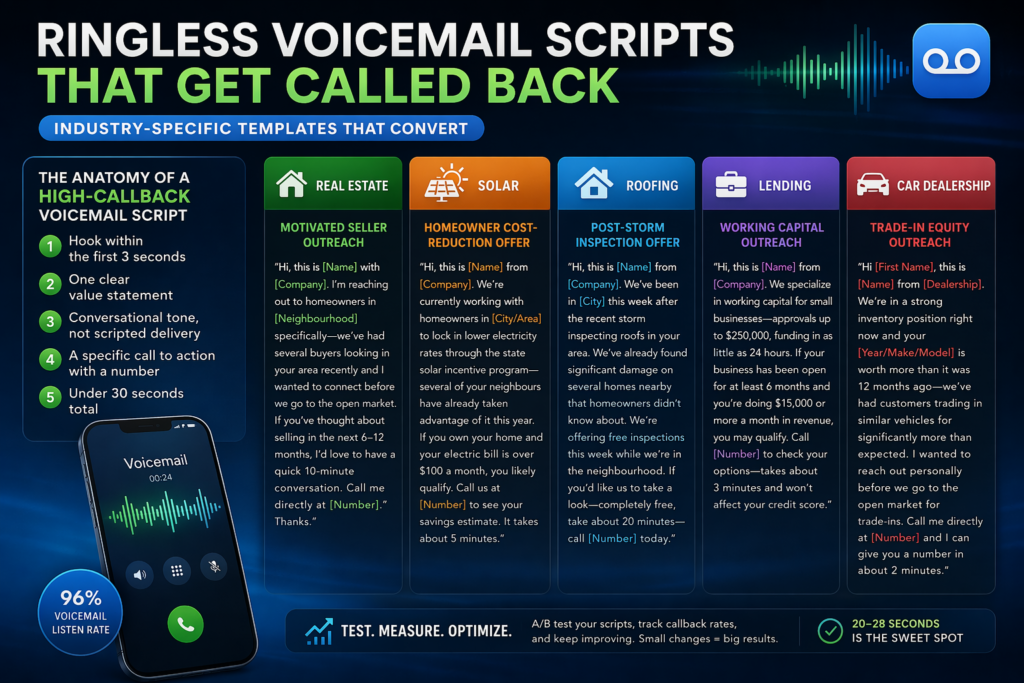
The Anatomy of a High-Callback Voicemail Script
Before getting into industry templates, there are five principles that apply universally to any RVM script that converts:
1. Hook within the first 3 seconds. Most people decide whether to listen or delete in the first few seconds. Lead with something relevant to them specifically their neighbourhood, their situation, a time-sensitive opportunity not with your name or company.
2. One clear value statement. Don’t try to explain everything. Say one compelling thing that gives them a reason to call back. If you can’t summarise the value in a single sentence, your offer isn’t clear enough yet.
3. Conversational tone, not scripted delivery. Listeners can instantly detect a read-aloud script. Record in a natural, slightly informal tone the way you’d leave a message for someone you know professionally. Re-record until it doesn’t sound like you’re reading.
4. A specific call to action with a number. Tell them exactly what to do and give them a direct number to reach a real person. “Press 1” or “call back at” both work, but vague CTAs like “visit our website” are conversion killers in voice format.
5. Under 30 seconds total. The sweet spot is 20–28 seconds for most campaigns. Beyond 30 seconds, listen-through rates drop and callback rates decline with them. Edit ruthlessly.
Real Estate Scripts
Real estate is one of the top industries using ringless voicemail because the economics are obvious: a single closed transaction justifies thousands of drops. The challenge is differentiation in a market where homeowners are bombarded with real estate outreach.
Motivated Seller Outreach:
“Hi, this is [Name] with [Company]. I’m reaching out to homeowners in [Neighbourhood] specifically we’ve had several buyers looking in your area recently and I wanted to connect before we go to the open market. If you’ve thought about selling in the next 6–12 months, I’d love to have a quick 10-minute conversation. Call me directly at [Number]. Thanks.”
Why it works: Opens with neighbourhood-specific targeting (relevance signal), implies demand without hype, sets low commitment expectation (10 minutes), ends with a direct number.
Open House Promotion Neighbour Drop:
“Hi, this is [Name] I just listed a home at [Address] in your neighbourhood and I wanted to make sure local residents heard about it first. We’re hosting an open house this [Day] from [Time]. If you know anyone looking to move to the area or if you’ve been thinking about the market yourself I’d love to see you there. [Number] if you have questions.”
Why it works: The “local residents first” framing creates insider status. Opens a door for sellers without stating it directly. Event format creates urgency.

Solar Scripts
Solar campaigns live and die on qualification. A high volume of callbacks from unqualified homeowners, renters, apartments, shaded properties burns agent time. The best solar RVM scripts do light qualification work within the message itself by referencing homeownership and electricity costs.
Homeowner Cost-Reduction Offer:
“Hi, this is [Name] from [Company]. We’re currently working with homeowners in [City/Area] to lock in lower electricity rates through the state solar incentive program several of your neighbours have already taken advantage of it this year. If you own your home and your electric bill is over $100 a month, you likely qualify. Call us at [Number] to see your savings estimate. It takes about 5 minutes.”
Why it works: References social proof (neighbours), includes a soft qualification filter (own your home, $100+ bill), minimises time commitment, ties to an incentive program for credibility.
Post-Storm / High-Bill Trigger:
“Hi, this is [Name] with [Company]. Utility rates in [State] went up again this quarter [City] homeowners are paying an average of [X]% more than two years ago. We’re scheduling free energy assessments this week for homeowners who want to see what solar would actually save them. No obligation, no salesperson, just numbers. Call [Number] or we’ll call you back.”
Why it works: Opens with a local, credible pain point, removes the “salesperson” fear which is a common objection, ends with a two-way CTA.
Roofing Scripts
Roofing campaigns often run in response to weather events hailstorms, high winds, seasonal inspection pushes. The best scripts acknowledge the external trigger and lead with a service offer rather than a sales pitch. Roofers using Drop find that post-storm drops to affected ZIP codes can generate callbacks within hours.
Post-Storm Inspection Offer:
“Hi, this is [Name] from [Company]. We’ve been in [City] this week after the recent storm inspecting roofs in your area. We’ve already found significant damage on several homes nearby that homeowners didn’t know about. We’re offering free inspections this week while we’re in the neighbourhood. If you’d like us to take a look completely free, take about 20 minutes to call [Number] today.”
Why it works: Establishes physical presence in the area (trust signal), creates FOMO with “homes nearby,” time-limited offer, free removes price resistance.
Seasonal Maintenance Spring/Fall Push:
“Hi, this is [Name] with [Company]. Spring is the best time to catch small roof issues before they turn into expensive repairs and we’re scheduling free inspections in [Neighbourhood] this week. Homes built in [Year Range] particularly benefit from a check-up this time of year. Call us at [Number] to book a slot. We’ll be in your area through [Date].”
Why it works: Seasonal relevance, home age targeting (personalisation signal), time-limited availability, educational framing rather than a sales push.
Business Lending Scripts
Business lending has a compliance-sensitive environment, and RVM scripts for this sector need to be careful about claims while still being compelling. The best performing scripts for business lenders on Drop focus on speed, simplicity, and a low-friction next step.
Working Capital Outreach:
“Hi, this is [Name] from [Company]. We specialize in working capital for small businesses approvals up to $250,000, funding in as little as 24 hours. If your business has been open for at least 6 months and you’re doing $15,000 or more a month in revenue, you may qualify. Call [Number] to check your options takes about 3 minutes and won’t affect your credit score.”
Why it works: Specific numbers build credibility, qualification criteria filters to qualified prospects, removes the credit-check friction point which is a common objection.
Car Dealership Scripts
Dealership RVM campaigns run in two primary modes: conquest (new prospects from the market) and database (existing customers for service, trade-in, or upgrade). The script approach is very different for each. Dealerships using Drop get the best results when they treat database drops as a personal outreach rather than a broadcast.
Trade-In Equity Outreach (Database):
“Hi [First Name], this is [Name] from [Dealership]. We’re in a strong inventory position right now and your [Year/Make/Model] is worth more than it was 12 months ago we’ve had customers trading in similar vehicles for significantly more than expected. I wanted to reach out personally before we go to the open market for trade-ins. Call me directly at [Number] and I can give you a number in about 2 minutes.”
Why it works: Personal tone with first name, specific vehicle reference increases relevance, creates a sense of insider opportunity, direct agent number implies a real person waiting.
Sales Event Promotion (Conquest):
“Hi, this is [Name] from [Dealership] in [City]. We’re running our [Event Name] this weekend [Specific Incentive] on [Popular Models]. We have 40+ vehicles in stock right now and financing rates are lower than they’ve been since 2021. If you’ve been thinking about making a move, this is the weekend to come in. [Number] or stop by [Address].”
Why it works: Event creates urgency, inventory specificity signals selection is available, financing rate reference is timely and relevant, includes both a call and a walk-in option.
Script Testing and Optimisation
Even great scripts can be improved. Drop’s platform supports A/B testing across campaign batches send two versions to split segments of your list and measure callback rates. Common variables to test include the opening hook (neighbourhood mention vs. pain point lead), the CTA phrasing (“call me at” vs. “press 1 to connect”), and message length (20 seconds vs. 28 seconds).
Run each test with at minimum 500 contacts per variant to get statistically meaningful results. Once you identify a winner, that version becomes your control for the next round of testing. Over time, this iterative approach produces scripts that are refined to your specific audience and offer and callback rates that compound as a result.
For businesses running multiple industry campaigns, keeping a library of tested scripts organised by vertical, offer type, and season is worth the effort. What works for a spring roofing push in the midwest won’t translate directly to a fall solar push in the southwest, but the structural elements hook, value, CTA apply across all of them.

Frequently Asked Questions
How long should a ringless voicemail script be?
The optimal length for most industries is 20–28 seconds. This is long enough to deliver a complete message with a CTA, but short enough to hold attention through to the end. Scripts longer than 35 seconds see measurably lower listen-through rates.
Should I use my own voice or hire a professional voice actor?
For database campaigns targeting existing customers, your own voice (or your agent’s voice) outperforms a professional recording because familiarity builds trust. For cold prospect campaigns at scale, a professional voice actor with a warm, natural delivery can lift callback rates by making the message sound more polished. Test both with your specific audience.
What’s the best opening line for a cold prospect voicemail?
Lead with a hyperlocal or situation-specific reference rather than your name or company. “We’ve been working with homeowners in [Neighbourhood] this week” outperforms “Hi, my name is [Name] from [Company]” as an opener because it signals relevance before asking for anything. Start with them, not with you.
How do I make a ringless voicemail sound less like a robocall?
Record in a quiet space with no echo. Use a conversational pace slightly slower than normal speech. Include a minor imperfection (a slight pause, a natural “uh”) if it sounds too polished. Reference something specific to the recipient’s situation. Avoid marketing buzzwords. The goal is for it to sound like a colleague left a message, not a broadcast centre.
Can I personalise scripts with the recipient’s name or details?
Dynamic personalisation at the name level currently requires manual segmentation recording separate versions for different first names is not practical at scale. However, you can personalise at the segment level: different recordings for different ZIP codes, home age brackets, vehicle models, or account types. This segmented approach gives the feeling of personalisation without requiring individual recordings. Learn more about how Drop handles campaign segmentation.
Put These Scripts to Work
A great script is half the equation. The other half is a platform that delivers it reliably at scale with the reporting to tell you what’s working. Get started with Drop upload your first campaign list, record your message using the framework above, and measure your callback rate within 24 hours. No contracts, no monthly minimums, and pricing that scales with your volume from $0.05 per drop down to $0.006 at scale.
