

Most outreach is loud, generic, and slightly desperate.
Account-Based Marketing is the opposite. It is selective. Precise. Focused on high-value companies instead of spraying messages at anyone with a pulse and an inbox.
And yet, many ABM strategies still rely heavily on email and LinkedIn messages that drown in overcrowded feeds.
Ringless voicemail changes that dynamic.
Instead of fighting for screen space, you land directly in a decision-maker’s voicemail inbox with a tailored, intentional message that feels human, not automated. When done correctly, it becomes one of the most powerful tools inside a serious ABM strategy.
Let’s break down how to use ringless voicemail in ABM without sounding like every other “just checking in” sales rep on earth.
What Makes Ringless Voicemail a Natural Fit for ABM?
ABM is about depth, not volume.
You are targeting specific companies, specific decision-makers, and specific pain points. That level of precision demands a channel that supports personalization and context.
Ringless voicemail works well because:
- It feels direct and personal
- It avoids interrupting executives with cold calls
- It allows controlled, pre-crafted messaging
- It integrates easily into multi-touch campaigns
Unlike cold calling, ringless voicemail does not force a live interaction at the wrong moment. And unlike email, it does not depend on whether someone is filtering, archiving, or ignoring you.
It gives you presence without intrusion.
That’s rare.
Where Ringless Voicemail Fits Inside an ABM Strategy
ABM is rarely one channel. It is a coordinated, multi-touch sequence that builds familiarity over time.
If you have not already structured this, study how a proper multi-touch outreach funnel works before randomly dropping voice messages into the void.
In a typical ABM campaign, ringless voicemail can be positioned as:
- A pattern interrupt after email attempts
- A reinforcement touch after a LinkedIn connection
- A pre-call warm-up message
- A follow-up after a webinar or event
- A re-engagement tool for stalled enterprise deals
The key is coordination. A voicemail without context is noise. A voicemail supported by thoughtful messaging across channels becomes memorable.

Crafting ABM Voicemail Messages That Don’t Sound Generic
Here’s where most campaigns collapse.
ABM is not “Hi {{FirstName}}, I noticed you work at {{Company}}.”
That’s personalization theatre.
For high-value accounts, your voicemail must demonstrate that:
- You understand their industry
- You understand their role
- You understand a real problem they likely face
An ABM voicemail should include:
- Context specific to their company
- A relevant insight or observation
- A clear reason for reaching out
- A low-friction next step
Example structure:
- Open with relevance
- Reference a trigger event (funding round, expansion, hiring, product launch)
- Tie it to a problem
- Offer value
- Suggest a simple follow-up
Because yes, tone matters. Pace matters. Confidence matters. Your script should sound like a professional conversation, not a robotic recital.
Using Ringless Voicemail for Named Account Penetration
ABM often targets multiple stakeholders inside one organization.
You might be reaching:
- A CMO
- A Head of Sales
- A VP of Operations
- A Director of RevOps
Instead of blasting the same message to all of them, you adjust the angle.
For marketing leaders, you talk pipeline influence.
For sales leaders, you talk conversion rates.
For operations, you talk efficiency and scalability.
Ringless voicemail allows you to tailor each message without needing live availability.
It becomes especially powerful when layered with CRM segmentation. If you have not integrated voicemail into your system yet, review how to approach CRM integration strategically.
When synced properly, your outreach becomes triggered, sequenced, and measurable rather than improvised.
Coordinating ABM Voicemail with Enterprise Telephony Infrastructure
Let’s be realistic. High-value accounts expect professionalism.
If someone calls back, your system needs to handle it properly.
That is where strong telephony software becomes essential.
ABM is not just about sending messages. It is about managing responses.
When a decision-maker returns your call:
- The call should route correctly
- Context should be visible
- The conversation should continue seamlessly
If inbound responses are mishandled, you destroy the credibility you just built.
For teams operating at scale, pairing voicemail outreach with structured call center software ensures inbound interest is managed efficiently.
Because nothing says “enterprise-ready” like a callback that goes nowhere.
Measuring Influence, Not Just Direct Conversions
Here is where most marketers oversimplify.
ABM does not always generate instant replies.
Sometimes it increases:
- Email open rates
- LinkedIn response rates
- Meeting acceptance
- Brand familiarity
- Sales cycle acceleration
You need analytics that go beyond “Did they call back?”
For deeper performance tracking, study how to evaluate ringless voicemail analytics properly.
In ABM, voicemail might:
- Increase reply rates on subsequent touches
- Improve meeting show-up rates
- Shorten time to close
Those influence metrics matter more than raw response volume.
Trigger-Based ABM Voicemail Campaigns
The best ABM campaigns are not random.
They are triggered.
Consider sending voicemail messages when:
- A company announces funding
- A target account hires aggressively
- A competitor launches a product
- A prospect downloads high-intent content
- A lead visits pricing pages multiple times
This makes your outreach feel timely, not opportunistic.
When structured through automation workflows, voicemail can become part of a broader funnel.
ABM does not mean manual chaos. It means intelligent orchestration.
Leveraging IVR to Capture High-Intent Responses
Not every executive wants to call back and immediately speak to sales.
Some prefer options.
Integrating voicemail campaigns with a well-designed IVR system allows you to:
- Route calls to specific teams
- Offer callback scheduling
- Provide brief informational prompts
- Direct inquiries efficiently
This is particularly valuable for enterprise ABM where different stakeholders may require different follow-up paths.
A CFO should not land in the same queue as a general inquiry.
Avoiding Common ABM Voicemail Mistakes
Even sophisticated teams mess this up.
Here are common errors:
Overly Long Messages
Executives are not listening to your life story. Keep it under 30 seconds.
Vague Value Propositions
“Helping companies like yours grow” means nothing. Specificity wins.
Lack of Cross-Channel Coordination
Voicemail without email or LinkedIn support is weak.
No Clear Next Step
Tell them what to do. Reply. Book time. Call back. Visit a page.
Sending Too Frequently
ABM is about precision. Do not turn it into harassment.
Timing can be the difference between strategic and annoying.
Ringless Voicemail vs Cold Calling in ABM
Cold calling still exists. Somehow.
But for ABM, especially at the executive level, live cold calls often feel intrusive.
Ringless voicemail:
- Respects time
- Preserves professionalism
- Allows thought-out messaging
- Creates familiarity before live conversation
The goal in ABM is not to interrupt. It is to influence.
Scaling ABM Without Losing Personalization
There is always tension between scale and authenticity.
ABM does not mean manually recording 500 messages daily. It means segmenting intelligently.
You can:
- Create industry-specific templates
- Personalize opening lines
- Use trigger-based workflows
- Adapt scripts by role
Combined with robust infrastructure and analytics, ringless voicemail becomes a scalable ABM lever rather than a manual burden.
The magic happens when automation supports personalization instead of replacing it.
The Strategic Advantage of Voice in Enterprise Outreach
Voice communicates tone, authority, and confidence in ways text cannot.
In enterprise sales cycles that last months, familiarity compounds.
Hearing your voice multiple times:
- Builds recognition
- Reduces friction
- Creates psychological presence
That subtle familiarity often increases response probability across other channels.
It is not about forcing engagement. It is about earning it.
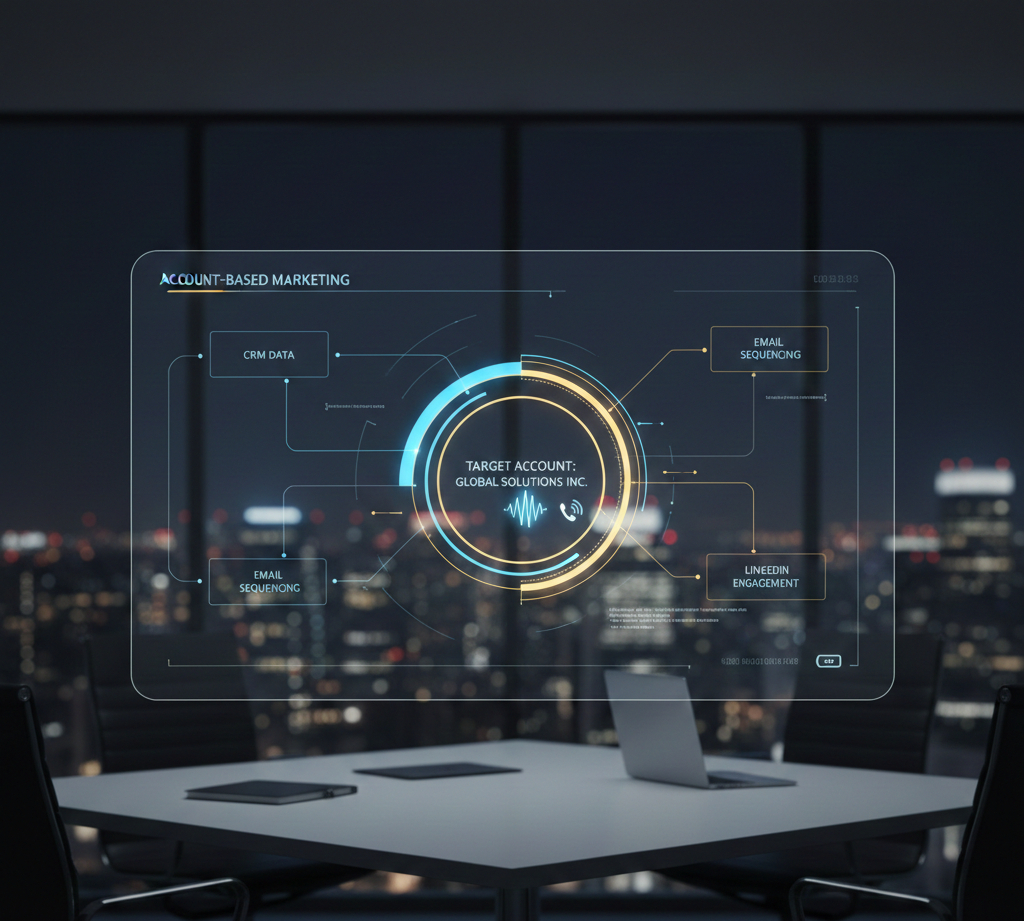
Ringless Voicemail as an ABM Multiplier
ABM demands precision, timing, and thoughtful execution.
Ringless voicemail fits naturally into that framework because it:
- Supports personalization
- Enhances multi-touch sequences
- Respects executive time
- Integrates with enterprise telephony systems
- Provides measurable influence
Used carelessly, it becomes noise.
Used strategically, it becomes a differentiator in high-value account penetration.
In a world where inboxes are overloaded and calls go unanswered, a well-crafted voice message placed at the right moment might be the quiet advantage your ABM strategy needs.
And if you are targeting accounts worth six or seven figures, subtle advantages are not optional.
They are everything.
Why Drop Is Built for Enterprise ABM Execution
Strategy is cute. Execution is what closes enterprise deals.
If you are running serious ABM campaigns, you need more than a voicemail tool that simply “sends messages.” You need infrastructure that supports:
- CRM-triggered workflows
- Enterprise-level scalability
- Reliable deliverability
- Analytics that go beyond vanity metrics
- Seamless integration with your broader communication stack
That is where Drop becomes more than just a feature.
Drop enables marketing and sales teams to deploy ringless voicemail as part of a structured outreach ecosystem. Whether you are targeting 50 named accounts or orchestrating complex campaigns across multiple stakeholders inside global enterprises, the platform supports:
- Precision targeting
- Automated sequencing
- Advanced performance tracking
- Integration with telephony environments
- Scalable infrastructure for growing teams
When paired with structured systems like IVR, call routing, and enterprise-grade telephony, Drop transforms ringless voicemail from a tactic into a strategic ABM lever.
If your team is serious about penetrating high-value accounts instead of casually “touching base,” you need tools that match that ambition.
FAQs
What is the role of ringless voicemail in an ABM strategy?
Ringless voicemail supports Account-Based Marketing by delivering personalised, non-intrusive messages directly to decision-makers. It enhances multi-touch campaigns without relying solely on email or cold calls.
Is ringless voicemail effective for enterprise-level accounts?
Yes. When tailored to specific stakeholders and supported by proper infrastructure, ringless voicemail increases familiarity, improves response rates across channels, and strengthens overall account penetration.
How should ringless voicemail be coordinated within an ABM campaign?
It should be integrated into a structured multi-touch sequence that includes email, LinkedIn, and other outreach methods. Timing, relevance, and cross-channel alignment are critical for success.
Can ringless voicemail integrate with CRM and telephony systems?
Yes. Enterprise execution requires CRM-triggered workflows, analytics tracking, and integration with telephony systems to manage inbound responses efficiently and maintain continuity.
How do you measure the success of ringless voicemail in ABM?
Success is measured not only by callbacks but also by increased engagement across channels, meeting acceptance rates, sales cycle acceleration, and overall influence within target accounts.
Ready to Turn ABM Strategy Into Measurable Revenue?
If you’re ready to use ringless voicemail as a true competitive advantage within your Account-Based Marketing strategy, Drop is built to support enterprise-level execution.
Contact Drop to discuss your ABM goals, integration requirements, and outreach infrastructure.
Enterprise accounts require precision, scalability, and control. Drop gives you the tools to execute high-value outreach with confidence and consistency.
