

Businesses today need outreach systems that reach more people, create more personalised interactions and move leads through the funnel faster than traditional channels can manage. Cold calls feel intrusive, email open rates keep falling and SMS can come off as abrupt when it’s overused. Ringless voicemail sits in a comfortable middle ground. It places a message directly into a person’s voicemail inbox without interrupting them, which makes it more respectful and often more effective. When you take that concept and elevate it with API automation, you end up with a scalable machine that can send, track and optimise thousands of personalised messages at once.
Ringless Voicemail APIs let organisations streamline outreach, connect voicemail drops to CRM data, and build automated journeys that respond to customer behaviour in real time. Instead of teams manually uploading lists or sending one-off campaigns, APIs handle the heavy lifting so humans can focus on strategy.
Why Ringless Voicemail APIs Matter
APIs turn ringless voicemail from a handy outreach tactic into a powerful automation system. The main advantage is scale. Manually running campaigns quickly becomes unmanageable once the contact volume goes beyond small batches. APIs automate the entire chain of tasks, from initiating voicemail drops to updating CRM records with delivery results. This keeps outreach predictable and efficient even when the audience grows into the tens of thousands.
Another major advantage is real-time personalisation. An API-driven system can adapt each message to variables like lead status, purchase history, behaviour triggers, demographic details or the specific product someone inquired about. Instead of blasting the exact same message to every contact, the workflow becomes responsive and personalised without requiring dozens of different audio files.
APIs are also ideal for integration. Ringless voicemail becomes far more powerful when it’s connected to a company’s CRM, email platform, SMS system, lead-capture forms or internal software. Everything runs through a single ecosystem instead of being a disconnected standalone tool. Sales teams, marketing departments and support staff can all rely on the same messaging engine without needing to rebuild processes from scratch.
Consistency is another benefit people underestimate. When multiple departments or franchise locations rely on the same outreach process, an API ensures messages are delivered at the right time, using the correct audio, with the right data and in the correct format. Humans are inconsistent; APIs are not.
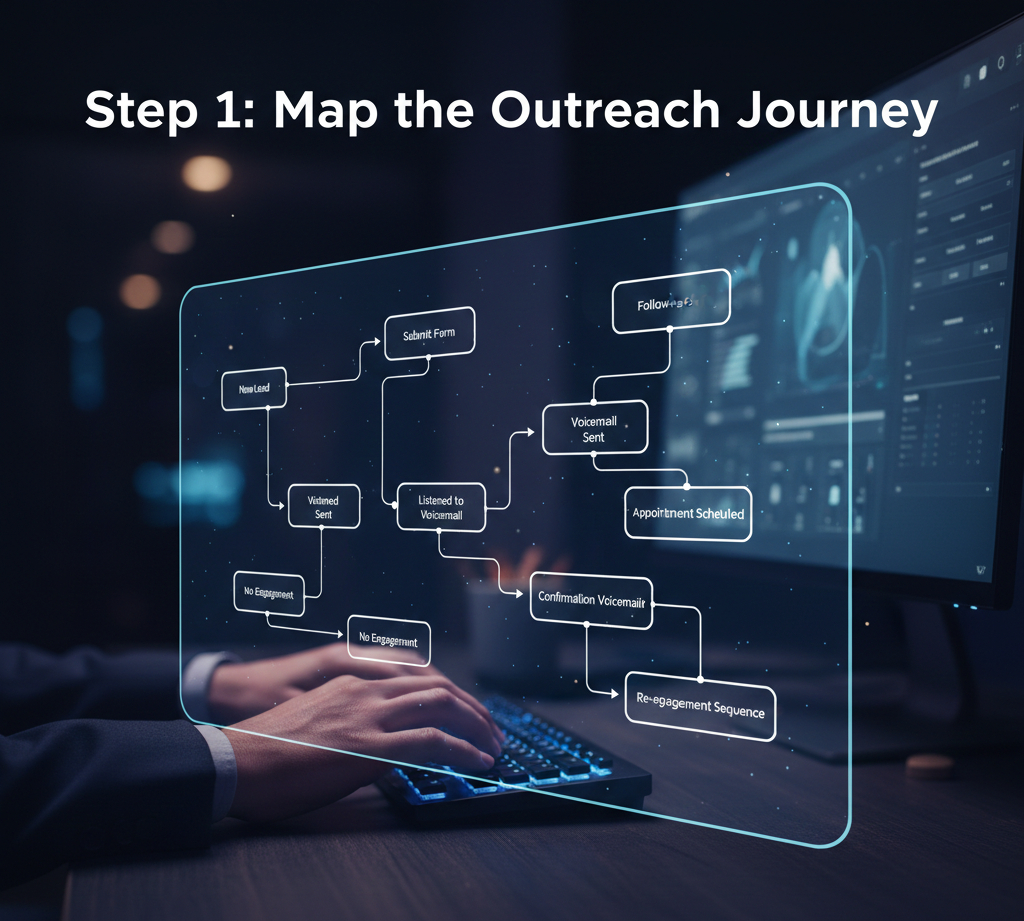
Step 1: Map the Outreach Journey
Building a scalable workflow starts with understanding the journey you want contacts to experience. Before touching any technical setup, you need clarity on who should receive voicemails, when the messages are triggered, what the voicemail is supposed to accomplish and how the rest of the communication sequence supports it.
For example, you might decide that new leads receive a friendly voicemail within minutes of submitting a form. If they listen to it, the system follows up with a short SMS. If they don’t engage within a day, the lead moves into a different sequence. If a customer schedules an appointment, they receive a confirmation voicemail. If they miss that appointment, a reminder voicemail goes out automatically. This journey planning is the blueprint that the API will execute.
Step 2: Set Up Your API Environment
Most ringless voicemail providers supply API keys, documentation, sample code and endpoint references. The core functionality usually revolves around authenticating your application, creating or triggering voicemail drops, uploading or passing contact data, scheduling delivery and retrieving reports. With these capabilities, your system can send messages instantly or on a schedule, adapt them using variables and track delivery or listen actions as they occur.
When you set up your environment, store API keys securely and keep them out of source code. Use environment variables, create logs for all API calls and define retry rules for network errors. A stable environment ensures smooth performance even when you’re pushing large volumes of requests through the system. Many teams also rely on advanced telephony software to handle call routing, carrier management and large-volume message distribution during peak outreach periods. This ensures the outreach pipeline stays stable even as the campaign scales.
Step 3: Create and Optimise Your Voicemail Audio
The message itself still matters more than the technology behind it. Even the best API workflow won’t help if your audio is low quality or your script feels robotic. Use a clear, natural-sounding voice, keep the message around twenty to thirty-five seconds, and make sure the tone is friendly without sounding like a hard sell. A good voicemail explains who you are, why you’re reaching out, what value the listener gets from paying attention and what simple action they should take next.
Personalisation can be woven into the script through variables like the contact’s first name, the product they asked about, appointment details, location or the name of the representative handling the account. This keeps the recording relevant without requiring a different audio file for every situation. APIs merge the template with contact-specific data at the moment of delivery, maintaining both scale and authenticity.

Step 4: Connect Ringless Voicemail to Your CRM or Marketing Platform
This is where the workflow truly becomes scalable. CRMs and marketing systems contain the data and triggers that determine when outreach should occur. By connecting the API, you create an automated engine that sends voicemails based on behaviour or timeline rules.
A lead entering the CRM can instantly receive a voicemail. A user who abandons a shopping cart can receive a voicemail followed by an SMS reminder. Someone who books an appointment can receive an automated confirmation message. Leads who haven’t been contacted for thirty days can be placed into a re-engagement sequence. The system becomes smart, responsive and automatic.
You can do this with major CRMs like HubSpot, Salesforce, Zoho, Pipedrive, Keap or Monday, or with custom in-house systems. Integrations can run through middleware tools or direct server-to-server connections, depending on how customised you want the workflow to be. When the outreach volume grows, pairing Ringless Voicemail APIs with modern call center software helps keep every conversation organised and ensures agents can step in instantly when a lead replies. This creates a clean handoff between automated and human-driven communication.
Step 5: Build a Multi-Channel Follow-Up Sequence
Ringless voicemail is strongest when paired with other communication channels in a coordinated sequence. After the voicemail lands, the next steps might include an SMS with a concise call to action, an email that expands on the message, retargeting ads to reinforce the offer and eventually a follow-up call when appropriate.
For example, the workflow might send a voicemail immediately after a lead submits a form. Thirty minutes later, an SMS goes out if the voicemail has been delivered. The next morning an email arrives with more details. If there is no engagement two days later, the system assigns the lead to a human rep for a personalised outreach call. All of this happens automatically, guided by data. A scalable workflow often uses interactive voice response systems to route leads, trigger automations and customise follow-up paths without manual intervention.
Once a lead converts, the workflow transitions them to an onboarding or nurturing sequence. If they don’t convert, they can be enrolled in a long-term follow-up cycle without manual intervention.
Step 6: Monitor API Performance and Outreach Analytics
An automated workflow is only as strong as the data guiding it. Ringless voicemail APIs typically provide real-time delivery information, listen rates and other engagement signals. Monitoring these results allows you to refine your scripts, adjust your timing and improve your targeting.
You’ll want to pay attention to delivery rates, listening behaviour, callback responses, SMS replies, conversion results and opt-out patterns. Technical indicators such as carrier filtering, failed drops, incompatible voicemail systems, API timeouts or queue delays also matter. These details help you identify issues before they affect the entire campaign.
Step 7: Optimise Through Testing and Feedback Loops
A scalable outreach system is never static. It improves continuously through testing and data-driven refinement. A/B tests can compare different scripts, voices, call-to-action phrasing, time-of-day delivery or audience segments. Adaptive messaging can shift depending on how leads behave, how recently they engaged or what stage of the funnel they’re in. Automated list hygiene ensures that your outreach focuses on reachable, high-quality contacts rather than wasting effort on invalid or unresponsive numbers.
Over time, these iterative improvements create a workflow that becomes more efficient, more relevant and more personalised.
Step 8: Prepare for High-Volume Scaling
Once your outreach really grows, the volume alone can strain poorly designed systems. You need to account for constraints like carrier throttling, rate limits, queue management and server load. Spread voicemail drops across appropriate time windows, use parallel processing responsibly, pre-load audio assets instead of re-uploading them and rely on asynchronous queues to handle large batches smoothly. Caching responses and monitoring error rates helps maintain stability as volume increases.
A properly engineered outreach pipeline can handle tens or even hundreds of thousands of voicemail drops without slowing down or compromising performance.

Step 9: Maintain Compliance and Protect User Data
Scalable automation introduces legal responsibilities. Outreach must follow regional regulations regarding consent, privacy, message classification and opt-out mechanisms. Data transfers must be secure, user preferences must be honoured and businesses need clear documentation of how their workflow operates. Using an API doesn’t change compliance obligations; it simply streamlines execution.
Scaling Outreach the Smart Way with Ringless Voicemail APIs
A scalable outreach workflow built on Ringless Voicemail APIs turns one of the most human communication methods into an efficient, automated system. With mapping, integration, thoughtful scripting, multi-channel support, real-time analytics and continuous optimisation, organisations can deliver thousands of personalised voicemail messages without losing the personal touch. When implemented well, this kind of workflow becomes a long-term asset that grows with the business and strengthens every stage of the customer journey. Automate your outreach, connect smarter, and grow faster with Drop. Try it now!
